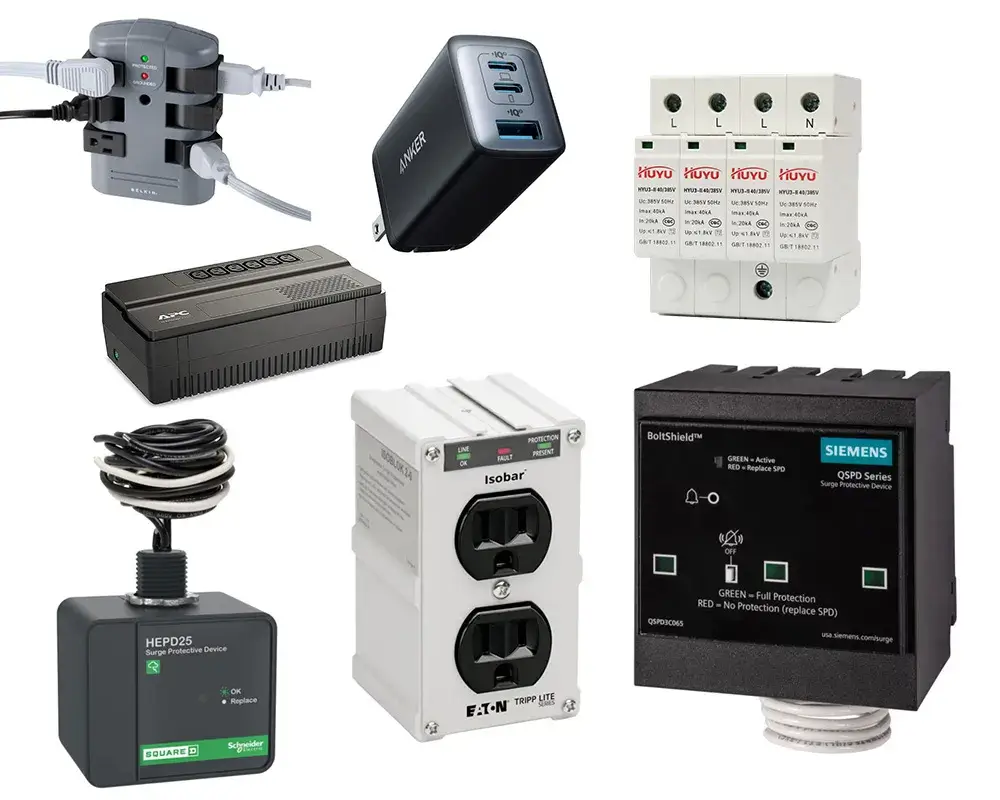
It may not. An ordinary power strip primarily gives you additional outlets. A genuine surge protector includes circuitry designed to limit short voltage spikes before they reach connected equipment.
The right product depends on more than the number of outlets. You must consider the electrical system in your country, surge rating, certification, outlet spacing, protection indicators, cord length, and the type of equipment you plan to connect.
Surge Protectors Worth Considering
| Product | Ideal use | Connections | Protection | Electrical market |
|---|---|---|---|---|
| Belkin PivotPlug BP112230-08 | Entertainment centers | 12 AC outlets | 4,320 joules | 120V North America |
| Eaton Tripp Lite ISOBAR8ULTRA | Workstations and network equipment | 8 AC outlets | 3,840 joules | 120V North America |
| Anker 351 Power Strip | Desks and charging stations | 12 AC, 1 USB-C, 2 USB-A | 2,100 joules | Verify exact regional model |
| Furman PST-8 | Premium audio and home theater | 8 filtered AC outlets | SMP, LiFT and EVS protection | 120V North America |
| Belkin BSV804sa2M | International home and office setups | 8 AC, 2 USB-A | 900 joules | 220–240V regional version |
Belkin PivotPlug: Designed for Large Power Adapters
The Belkin PivotPlug BP112230-08 is a practical choice for televisions, game consoles, streaming boxes, speakers, and other home-entertainment equipment.
It provides 12 surge-protected outlets and a 4,320-joule rating. Eight outlets rotate, allowing bulky power adapters to face away from neighboring sockets. This solves one of the most frustrating problems with conventional strips: owning 12 outlets but being able to use only seven or eight of them.
The eight-foot cord also gives you more placement flexibility behind furniture. However, this is a 120V North American product. It should not be connected to a 230V supply through a simple plug adapter.
Eaton Tripp Lite ISOBAR8ULTRA: Built for Serious Workstations
The Eaton Tripp Lite ISOBAR8ULTRA is well suited to desktop computers, monitors, network switches, studio equipment, and demanding office environments.
Its eight outlets are divided into four isolated filter banks. This design helps prevent electrical noise generated by one connected device from interfering with equipment on another bank. The unit also has a sturdy metal housing, diagnostic lights, a 3,840-joule rating, and a long 12-foot cord.
The ISOBAR8ULTRA is larger and heavier than a typical plastic power strip, but that construction is an advantage in a permanent workstation or equipment rack. As with the Belkin PivotPlug, it is intended for 120V systems.
Anker 351: Convenient Protection for a Modern Desk
The Anker 351 Power Strip combines 12 AC outlets with one USB-C and two USB-A ports. Its flat layout and multiple charging connections make it particularly useful on a home-office desk.
It offers 2,100 joules of surge protection and includes a five-foot cord. The USB-C port can deliver up to 20 watts under the appropriate charging conditions. That is sufficient for many phones and small tablets, but it is not powerful enough to charge numerous performance laptops at their full speed.
Buyers should inspect the exact model label and local specifications. Anker sells different power products in different regions, and a similar appearance does not guarantee identical voltage support or certification.
Furman PST-8: Premium Protection for Audio and Video Equipment
The Furman PST-8 is aimed at people protecting costly televisions, projectors, amplifiers, studio monitors, and home-theater components.
Instead of competing primarily through a large advertised joule number, Furman uses its Series Multi-Stage Protection, Linear Filtering Technology, and Extreme Voltage Shutdown systems. The PST-8 can disconnect connected equipment during dangerous high-voltage conditions, while its filtering system is designed to reduce AC line noise.
All eight outlets are filtered and surge protected. The unit supports up to 15 amps and includes an eight-foot cord. It is an expensive option, but its robust construction and overvoltage shutdown make it attractive for high-value installations.
Do not confuse power conditioning with a guaranteed improvement in picture or sound quality. The PST-8 may help when electrical noise is genuinely present, but it cannot improve a clean digital signal by magic. It is also not a battery backup or voltage regulator.
Belkin BSV804sa2M: A 220–240V Option
People living in 220–240V regions should purchase a protector designed and certified for their electrical system. The regional Belkin BSV804sa2M provides eight AC outlets, two USB-A charging ports, a two-meter cord, and 900 joules of surge protection.
This is a more appropriate starting point for compatible 230V markets than importing a 120V power strip. Nevertheless, check the exact plug, outlet arrangement, frequency, voltage label, and local safety certification before ordering. Product versions can vary between countries even when their model names appear similar.
How to Read Surge-Protector Specifications
Joule rating
The joule rating describes how much surge energy a protector is designed to absorb or divert over its service life. A higher rating is generally desirable for valuable electronics, but it should not be the only deciding factor. Circuit design, certification, thermal protection, clamping performance, and status indicators also matter.
Voltage protection rating
A voltage protection rating, sometimes described as clamping or let-through voltage, indicates the voltage level that may reach connected equipment during a standardized surge test. When comparing products tested under the same standard, a lower rating generally indicates tighter protection.
Protected and grounded indicators
A “protected” light tells you whether the surge-protection circuitry remains operational. If that light goes out, replace the protector according to the manufacturer’s instructions. A missing ground light can indicate a wiring problem that should be inspected by a qualified electrician.
Outlet spacing
Count your devices and examine their adapters before buying. Rotating or widely spaced outlets are valuable when you have routers, speakers, external drives, and smart-home hubs with oversized plugs.
Safety certification
Look for certification appropriate to your market, such as UL 1449 for North American surge protectors or the relevant recognized standards for your country. Avoid unbranded strips that provide no verifiable electrical rating or certification information.
What a Surge Protector Cannot Do
A plug-in surge protector is not complete protection against every electrical problem. It cannot provide battery power during an outage, correct a prolonged brownout, or safely compensate for a consistently high supply voltage. A nearby or direct lightning event can also overwhelm point-of-use protection.
For expensive computers, NAS devices, routers, and other equipment that must remain operational, consider adding an uninterruptible power supply. For broader protection, ask a qualified electrician about a service-panel or whole-home surge protective device. Layered protection works best when the building has a properly grounded electrical system.
Surge-Protector Safety Rules
- Never connect one power strip or surge protector to another.
- Do not place the unit under a rug or where furniture can damage its cord.
- Do not exceed the protector’s current or load rating.
- Avoid connecting heaters, kettles, hair dryers, refrigerators, or similar high-power appliances unless the manufacturer specifically permits it.
- Replace a protector that is cracked, discolored, unusually warm, or has loose outlets.
- Replace it when its protection indicator goes out or after a major electrical event when advised by the manufacturer.
- Use the protector only with the voltage, frequency, and grounding system shown on its rating label.
Frequently Asked Questions
Is a higher joule rating always better?
A higher rating can provide greater energy-handling capacity, but two products should not be compared by joules alone. Certification, clamping performance, thermal safeguards, grounding, and protection-status indicators are equally important.
Can I use a 120V surge protector in a 230V country?
No, unless the exact product label explicitly states that it supports the local voltage and frequency. A travel plug adapter changes the physical connection; it does not make a 120V surge protector safe on a 230V circuit.
Do surge protectors last forever?
Many common protectors gradually wear as they absorb surge energy. Follow the manufacturer’s replacement guidance and watch the protected-status light. Physical damage, overheating, or a failed protection indicator means the unit should be removed from service.
Does a connected-equipment warranty guarantee reimbursement?
No. These warranties normally include claim procedures, exclusions, purchase requirements, and coverage limits. Keep your receipt and read the complete terms instead of treating the headline coverage amount as insurance.
Final Recommendation
For a North American entertainment center, the Belkin PivotPlug offers an excellent combination of outlet capacity, adapter-friendly spacing, and surge rating. The Eaton ISOBAR8ULTRA is better suited to heavy-duty workstations, while the Anker 351 is convenient for desks that need integrated USB charging. The Furman PST-8 is the premium choice for high-value audio and video systems.
In a 220–240V country, begin with a locally compatible model such as the appropriate regional version of the Belkin BSV804sa2M. Above all, verify the electrical rating printed on the product itself. The most impressive surge protector is useless—and potentially dangerous—if it was designed for a different power system.